Mostrando entradas con la etiqueta 1974. Mostrar todas las entradas

domingo, 29 de mayo de 2011

Scott-Heron, Gil - 1974 - Winter in America

Gil Scott-Heron was at his most righteous and provocative on this album. The title cut was a moving, angry summation of the social injustices Scott-Heron felt had led the nation to a particularly dangerous period, while "The Bottle" was a great treatise on the dangers of alcohol abuse. He also offered his thoughts on Nixon's legacy with "The H2O Gate Blues," a classic oral narrative. Brian Jackson's capable keyboard, acoustic piano and arranging talents helped make this a first-rate release, one of several the duo issued during the 1970s.

1 Peace Go With You, Brother (As-Salaam-Alaikum) Jackson, Scott-Heron 5:27
2 Rivers of My Fathers Jackson, Scott-Heron 8:19
3 A Very Precious Time Jackson, Scott-Heron 5:17
4 Back Home Jackson, Scott-Heron 2:51
5 The Bottle Scott-Heron 5:14
6 Song for Bobby Smith Scott-Heron 4:38
7 Your Daddy Loves You Scott-Heron 3:25
8 H2O Gate Blues Scott-Heron 8:08
9 Peace Go With You, Brother (As-Salaam-Alaikum) Jackson, Scott-Heron 1:10
10 Winter in America Scott-Heron 8:23
11 Song for Bobby Smith Scott-Heron 4:46
12 Your Daddy Loves You Scott-Heron 4:25
13 The Bottle/Guan Guanco Scott-Heron 11:56

¡Aquí!

sábado, 28 de mayo de 2011

Yatha Sidra - 1974 - A Meditation Mass

Yatha Sidhra's only record, the aptly titled A Meditation Mass, is a strange mystical experience stretched over four parts that segue almost seamlessly into one another, though the Spalax CD has a slight break between tracks two and three, where the original record changed sides. (The earlier Laser Edge reissue ran the tracks without the break.) Though the record was released in the early '70s, it has that late-'60s acid-haze, hippie ambience without coming off clichéd or dated. It starts off with watery noises and a wind hum, until eventually a flanged acoustic guitar riff gently floats into the mix, very dreamy and hypnotic over the whir of electronics. The piece slowly ebbs and flows as other instruments are pulled into the strange cosmic drift of sounds: washes of cymbals, vaguely ethnic percussions, a flute, vibes, and other sounds, even some group chanting with electronically treated voices, while the guitar weaves steadily to keep it together as it slowly builds up. On the second and third part the band veers into far more free-form improvisation, from jazzy sections with an upbeat swing to electric guitar over a trance-like rhythm to a bizarre drum and flute duel to intense freakouts before once again becoming calm and relaxed. Part four winds the album up where it began, with the acoustic guitar riff and tribal percussion and spacy electronics and flute building up to more chanting -- there is no beginning or end. One might compare Yatha Sidhra with other Krautrock bands like Ash Ra Tempel, Popul Vuh, or Limbus 3, but Yatha Sidhra's striking originality is like nothing else.

1 A Meditation Mass, Pt. 1 Fichter, Fichter 17:43
2 A Meditation Mass, Pt. 2 Fichter, Fichter 2:59
3 A Meditation Mass, Pt. 3 Fichter, Fichter 11:59
4 A Meditation Mass, Pt. 4 Fichter, Fichter 7:16

¡Aquí!

jueves, 29 de octubre de 2009

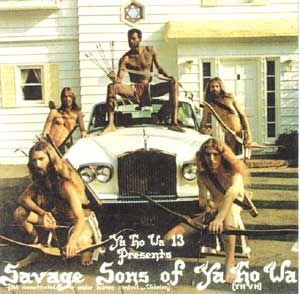
Yahowa 13 - 1974 - Savage Sons Of Yahowa

Father Yod/Yahowa's strange journey continued to take unpredictable twists on Yahowa 13's second album. Like Father Yod & the Spirit of '76's All or Nothing at All, this was so sonically unrelated to any of their prior recordings that it sounded like the work of an entirely different group of musicians. Unlike All or Nothing at All, it was also a change for the better. Not entirely accidentally, Father Yod himself does not appear on the album, ceding control of the music to Sunflower Aquarian, Djin Aquarian, Rhythm Aquarian, and Octavious Aquarian. It is obvious that one or more of these guys must have been huge Neil Young & Crazy Horse fans, as about half the songs are rougher approximations of his hard rock sound circa the early 1970s. And while those cuts are derivative, they're not half bad either. The vocals on "Edge of a Dream" are an especially spooky Neil Young soundalike, and "Red River Valley" has a nice hard rock spin on the kinds of melodies Neil used on compositions like "Old Man." "Making a Dollar" is rustic hard country-rock Crazy Horse with a touch of Harrisonesque Beatles. A few of the cuts eschew the overt Young influence for eccentric, roots-flavored hard rock. The vocals on these are so much throatier and blacker -- in the mode of a grainier Dr. John or War -- that it doesn't seem they could possibly be the work of the same singer. (The credits, as usual for Yahowa, don't shed any definite light on the situation.) This is the first Yod/Yahowa disc that can be accepted as a legitimate rock record on its own terms, rather than as a novelty of sorts. Were it done by some other obscure band on an independent label, one wouldn't think to make the connection between the music and the sort of eccentric mysticism that Yod and his followers practiced. The album has been reissued as one disc of the 13-CD God and Hair: Yahowha Collection box set.

1. Edge of a Dream (2:11)
2. Fire in the Sky (5:07)
3. Just Sitting Here (4:01)
4. A Thousand Sighs (7:30)
5. Red River Valley (4:48)
6. Man the Messiah (4:57)
7. Making a Dollar (5:34)
8. I Thought I Am (4:40)
9. Oh Ya Ho Wa (2:01)

¡Aquí!

jueves, 10 de septiembre de 2009

Van Morrison - 1974 - It's Too Late To Stop Now (2CD)

While Van Morrison is, to be kind, an erratic and temperamental live performer, he's in stellar form throughout the double album It's Too Late to Stop Now, a superb concert set that neatly summarizes his career from his days with Them (represented by scorching renditions of "Gloria" and "Here Comes the Night") through 1973's Hard Nose the Highway ("Warm Love," "Wild Children"). In addition to the hits, including "Caravan," "Domino," and "Into the Mystic" (the final line of which gives the album its title), Morrison even pulls out a handful of R&B chestnuts ("Bring It on Home to Me," "Ain't Nothin' You Can Do") before capping off the collection with a show-stopping rendition of Astral Weeks' "Cyprus Avenue." An engaging, warm portrait of the man at the peak of his powers.

¡Aquí!

sábado, 18 de julio de 2009

Otis, Shuggie - 1974 - Inspiration Information

Ignored upon its release in 1974 and celebrated upon its reissue in 2001, Shuggie Otis' fourth and last album Inspiration Information exists out of time -- a record that was of its time, but didn't belong of it; a record that was idiosyncratic but not necessarily visionary. It was psychedelic soul that was released far too late to be part of any zeitgeist and it was buried at the time. Yet no matter what Luaka Bop's grand poobah David Byrne claims on the sticker -- he says Shuggie's "trippy R&B jams are equal to Marvin's and Curtis', but somehow more contemporary sounding...closer to D'Angelo meets DJ Shadow" -- this isn't revolutionary. It can occasionally sound modern, such as on the rolling head trip "XL-30," but only because it's the kind of groove Shadow would sample and build on; the slow, liquid instrumental head trips sound the same way. Perhaps that's why it can seem more contemporary -- contemporary ears are more attuned to these relaxed, warmly trippy soundscapes. Otis crafted all of this essentially alone, playing each instrument himself, and it's quite clearly a reflection of his inner psyche, and no matter how much it floats and skates upon its own sound, it's a welcoming, inviting sound. But, no matter how much the partisans claim -- and their effusive praise is plastered all over the liner notes, with Sean O'Hagan claiming that it shocks you out of a rut, Stereolab's Tim Gane says it is "almost like a new style of music that could've developed but never did" -- this isn't revolutionary, even if it's delightfully idiosyncratic. So, don't fall for the hyperbole. This isn't an album that knocks your head off -- it's subtle, intricate music that's equal parts head music and elegant funk, a record that slowly works its way under your skin. Part of the reason it sounds so intriguing in 2001 is that there just aren't that many musicians that doggedly pursue their individual vision while retaining a sense of focus. But it isn't a record without precedent, nor is it startling. It's a record for people that have heard a lot of music, maybe too much, and are looking for a new musical romance. [Luaka Bop's reissue contains four fine bonus tracks, including the original version of "Strawberry Letter 23," which the Brothers Johnson later had a hit with. The reissue also replaces the original cover -- which is nowhere to be seen in the liner notes -- with a "hip," self-consciously retro cover. Also, it has put in the "World Psychedelic Classics" with Os Mutantes, which is slightly misleading and a little unsettling -- with that subheading, there's just a little too much self-conscious, scholarly distance at play.]


¡Aquí!