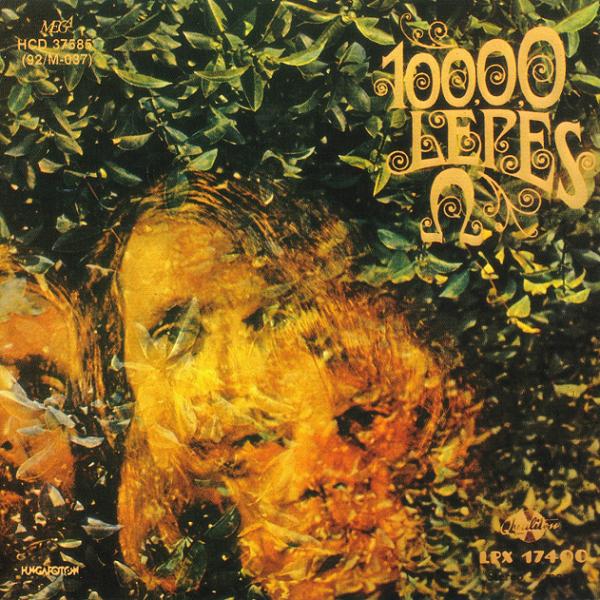
 Classic album from this legendary Hungarian band. In order to understand and appreciate what a remarkable acheivement this work was when it was recorded in 1968 it is perhaps necassary to briefly examine the constraints and restrictions faced by aspiring pop bands behind the veil of The Iron Curtain during the 1960's.
Despite the fact that Hungary was one of the first breakaway satelite countries both socially and economically under Josef Kadar's New Economic Mechanism implemented in 1966, a censorship board known as The Song Commitee had been established in order to syphen out any sensitive material which it deemed harmful to or which seeked to undermine the idealogical agenda of the state. This was a good thing and a bad thing for the bands. They could play their rock n'roll music, which in itself was considered to be symbolic of western capitalistic endeavours, but the lyrical contents were not to cross any fine lines politically. One has to bear in mind that this was the time when The Beatles were singing about a revolution, Bob Dylan was speaking his mind through the rock medium and closer to home in Western Europe bands like Amon Duul and Floh de Cologne were making political musical statements. It was the 60's man!
Omega originated as a student beat band , formed by a group of friends attending Budapest Technical College and played cover versions of songs from bands like the Beatles and Rolling Stones. In 1967 they released an album of original Hungarian language pop oriented songs which incorporated traditional Hungarian folk roots. The following year they recorded 10,000 Lepes and began to distance themselves from communist idealogies. Although technically, the album is raw sounding by contemporary western standards the influences were there. But they still clung to their folk roots in much the same way some British bands such as The Strawbs and the Irish prog band Fruup retained their folk heritage. The themes throughout the album are mostly mystical and full of legend and even if the listener is not familiar with the unique Hungarian language the music is very moody and appropriate to the individual song concepts. For example Tuzvihar ( Stormy Fire ) is a psychedelic blues based hard rock song which describes the story of a raging wildfire which ravages the country while the minor keyed symphonic Gyonghaju lany ( the Girl With The Pearls In Her Hair ) is about a beautiful girl who mysteriously appears and brings hope and solace to that dark and tormented world. Other suprises come in the form of Az 1958 as Boogie-woogie klubban ( In a Boogie- Woogie Club 1958) which is a rolicking piano piece accompanied by a catchy guitar hook that describes a good ole time in a boogie woogie club. Petroleum lampa ( Oil Lamp) is almost a pure folk song about an old oil lamp which is portrayed as a metaphor of false hope while Spanyol gitar legenda is a graceful ballad about a legend from another time in a far away place. The majestic title track 10,000 steps with it's continuous almost pompous drum beat is about an ongoing quest to march forward despite adversity and ties into other themes explored on the album. Who said Sgt. Peppers was the first concept album?
Omega evolved into the biggest rock act to emerge from Eastern Europe ever, recording in English and German touring Western Europe as well as Japan. Omega broke down barriers long before the Berlin Wall was broken down and for those who want a taste of what was going on behind The Iron Curtain rock-wise in the 1960's 10,000 Lepes is an interesting and important audio document which reveals the early Omega east meets west rock formula. Vintage Eastern European prog which rocked against the odds that takes the listener into a forbidden place in a dangerous time. Highly recomended for serious students of the prog rock genre.
| 1 | Petóleum Lampa | Adamis, Presser | 3:00 | |||
| 2 | Gyöngyhajú Lány | Adamis, Presser | 5:30 | |||
| 3 | Tüzvihar | Adamis, Molnar | 3:05 | |||
| 4 | Udvari Bolond Kenyere | Adamis, Presser | 3:35 | |||
| 5 | Kérgeskezü Favágók | Laux, Presser | 7:40 | |||
| 6 | Tékozló Fiúk | Adamis, Presser | 4:37 | |||
| 7 | Tíezer Lépés | Adamis, Presser | 6:00 | |||
| 8 | 1958-As Boogie-Woggie Klubban | Adamis, Presser | 2:05 | |||
| 9 | Spanyolgitár Legenda | Adamis, Mihaly | 3:15 | |||
| 10 | Félbeszakadt Koncert | Adamis, Kobor | 4:02 |
¡Aquí!


