Mostrando entradas con la etiqueta Progressive Metal. Mostrar todas las entradas

sábado, 14 de mayo de 2011

Coroner - 1985 - Death Cult EP

From their modest beginnings as roadies for avant-garde Swiss metal legends Celtic Frost, the members of Coroner carved out one of the most unique careers in the European thrash metal scene. The trio was originally pegged as a conventional thrash band, but their jaw-dropping musicianship and increasingly complex, almost prog rock compositions soon won over most critics, some of which labeled them the Rush of thrash metal. Over the course of eight years and six albums, the band fought constantly to expand the limiting boundaries of thrash, yet achieved only limited commercial success for their efforts. Still, their fearless experiments have allowed their albums to endure and stand the test of time better than many of their more celebrated peers.

Guitarist Tommy T. Baron (real name Thomas Vetterli) and drummer Marquis Marky (aka Marky Edelmann) put in various tours of duty as roadies for the seminal Celtic Frost before founding Coroner with bassist/vocalist Ron Royce in 1985. In fact, Frost main man Tom Warrior sang on their Death Cult demo. Subsequently signing to the German Noise label, the band debuted with 1987's R.I.P., then quickly followed it with 1988's Punishment for Decadence, which featured a surprising cover of Hendrix's "Purple Haze." With 1989's transitional No More Colour, Coroner truly inaugurated their golden era and raised their standards on every front: from the stylized album artwork to the slower, tighter rhythms and riffs which revealed their incredible technical proficiency to the experiments which began breaking away from the limitations of thrash metal, both musically and lyrically.

This ambitious vision came to full fruition with 1991's amazing Mental Vortex, which included a daring reconstructed cover version of the Beatle's "I Want You (She's So Heavy)." Recorded by top thrash producer Tom Morris, many expected the album to push Coroner's career to the next level and introduce them to a wider audience. But whether due to changing musical climates (alternative rock had just arrived) or simply being too ahead of its time, things just didn't play out that way. Disappointed though they were, the band regrouped and came up with an even more daring, unconventional album in 1993's Grin, which abandoned much of the thrash-based aggression of their early days and focused on challenging dynamics and eerie atmospherics. This move proved too radical even for longtime fans, ironically, and they remain split over the album's merits, some seeing it as a total sellout, while others consider it the band's greatest triumph. Coroner were apparently unsure themselves and succumbed to mounting inner tensions a short while later to go their separate ways.

Noise Records wasn't quite ready to let the band die, however, forcing guitarist Baron to compile 1995's Coroner (a collection of outtakes, new tracks, and classic cuts) nearly a year after the group's demise, which required the help of drummer Peter Haas stepping in for the uncooperative Edelmann. After this release, Vetterli temporarily fronted his own band, Clockwork, before joining German thrashers Kreator for one album. Edelmann assumed drum duties with his former mentor Tom Warrior's new band Apollyon Sun.


1. Spectators Of Sin 06:42
2. Spiral Dream 04:43
3. Aerial Combat 06:15
4. The Invincible 07:00

¡Aquí!

jueves, 24 de septiembre de 2009

Savatage - 1987 - Hall Of The Mountain King

With band members, critics, and fans unhappy with the commercialism of Fight for the Rock, Savatage began to disintegrate. However the new found acquaintance of producer Paul O'Neill not only changed the group's fortunes but soon pointed them in new directions. O'Neill, who was looking for a metal band to record some of his musical ideas, agreed to produce the group's next album, which became Hall of the Mountain King. A return to the form of Dungeons Are Calling, Hall of the Mountain King was the great album the band had always threatened to make. Featuring blistering guitar riffs, numerous tempo changes, and over-the-top screeching vocals, Savatage were finally captured by decent production after two albums of attempts to put a pop sheen on their music. Returning mostly to dark fantasy subject matter, "Devastation," "Legions," and the epic title track sounded more confident and tighter than anything on their previous two records, featuring dynamic rhythms courtesy of bassist Middleton and drummer Wacholz. The catchy pop-metal of "Strange Wings" was ironically a better song than any of the band's more blatant attempts at commercialism. Meanwhile, "24 Hours Ago," one of three tracks the group co-wrote with O'Neill, was an impressive opener with an interesting tempo changes and personal lyrics that pointed to the direction the band would soon take. Fans of the later, more progressive Savatage might not enjoy the group's earlier work, but this is a fine place to start looking.


¡Aquí!

lunes, 6 de julio de 2009

Dream Theater

The technically proficient guitar playing of John Petrucci elevated Dream Theater to the upper echelons of contemporary heavy metal. While its lineup has continuously evolved, the Long Island-based quintet has consistently delivered sharp-edged music. Dream Theater is known for its high-energy concert performances. While they've released several live albums -- Live at the Marquee, recorded at the London club; Live in Japan, recorded during the Music in Progress tour in 1993; and a triple CD and DVD, Live Scenes from New York -- they remain one of heavy metal's most bootlegged bands.

Originally named Majesty by Berklee College of Music students Petrucci, bassist John Myung, and drummer Mike Portnoy, the band soon expanded with the addition of keyboard player Kevin Moore and vocalist Chris Collins. Releasing an eight-tune demo, Majesty Demo, as Majesty, the group sold 1,000 copies within six months. The departure of Collins in late 1986 left Majesty without a vocalist, and after a long period of auditioning possible replacements, the group settled on Charlie Dominici in November 1987. Changing its name, the group agreed on "Dream Theater," inspired by a now-demolished California movie theater. Signing with Mechanic Records, the group began working on its first full-length album. Delays caused by label mismanagement limited the group to performing at small clubs and bars. Frustrated by its experiences with the label, Dream Theater finally severed its ties with Mechanic.

This was only one drastic change in the band's course of action. Firing Dominici, the group spent the next couple years searching for a vocalist. The search ended in late 1991 when a demo tape from Canadian vocalist James LaBrie, formerly of Winter Rose, arrived. After flying to New York to audition, LaBrie was invited to join the band. Signing with Atco Atlantic (which came to be known as East West), Dream Theater released its second album, Images & Words, in 1992. One of three videos based on songs from the album, "Pull Me Under," became an MTV hit. Although Theater showed considerable growth with their third studio album, Awake, recorded between May and July 1994, the group continued to be hampered by personnel changes. Before the album was mixed, keyboardist Moore left the group to focus on his solo career. Hired as a temporary replacement for the band's Waking Up the World tour, Derek Sherinian later became a permanent member. His first recording with Dream Theater was a 23-minute epic, "A Change of Seasons," written in 1989 and released in September 1995 on the album of the same name.

Following a mini tour, Fix for '96, the members of Dream Theater separated for several months and became involved with a variety of outside projects. Petrucci was the busiest. In addition to joining Portnoy and keyboard player Jordan Rudess in the Liquid Tension Experiment -- a group that included influential bassist/stick player Tony Levin -- Petrucci played guitar with Trent Gardner's Explorers Club and made a guest appearance on Shadow Gallery's Tyranny album. Myung and Sherinian collaborated with King's X vocalist Ty Tabor in the band Platypus. LaBrie worked with Mull Muzzler, a group formed with Matt Guillory and Mike Mangini.

Dream Theater experienced yet another change when Rudess was tapped to replace Sherinian, who had been fired in 1999. The band released the progressive rock-heavy Scenes from a Memory that year, a conceptual piece that followed the story of a 1928 murder of a young woman and how a modern man is haunted by the crime. It was followed by Live Scenes from New York in 2001, which suffered from an unintentional bout with controversy when its original cover featuring the city of New York in flames was pulled due to the events of September 11. The group continued in the progressive metal vein in 2002 with Six Degrees of Inner Turbulence, followed by the leaner Train of Thought in 2003 and Octavarium in 2005. The live album Score: XOX was released in 2006 and featured the band backed by a 29-piece orchestra. It was followed a year later by the new studio album Systematic Chaos, and in 2009 by Black Clouds & Silver Linings.

Sherinian went on to record as a soloist and to play with a prog and jazz fusion band, Planet X. Petrucci released an eponymously titled solo album in 2003, featuring accompaniment by Dave LaRue of the Dixie Dregs and Boston-based drummer Dave DeCenso.

2006 - 0119-Live At Olympic Fencing Gymnasium

Dream Theater - 2006 - 0119-Live At Olympic Fencing Gymnasium

!Aquí!

Megadeth

After he left Metallica in 1983, guitarist/vocalist Dave Mustaine formed the thrash metal quartet Megadeth. Though Megadeth followed the basic blueprint of Metallica's relentless attack, Mustaine's group distinguished themselves from his earlier band by lessening the progressive rock influences, adding an emphasis on instrumental skills, speeding the tempo up slightly, and making the instrumental attack harsher. By streamlining the classic thrash metal approach and making the music more threatening, as well as making the lyrics more nihilistic, Megadeth became one of the leading bands of the genre during the mid-'80s and late '80s. Each album they released went at least gold, and they continually sold out arenas across America, in addition to developing a strong following overseas. By the early '90s, they had toned their music down slightly, yet that simply increased their following; all of their proper '90s albums debuted in the Top Ten.

Throughout Megadeth's many lineup changes, the two core members were bassist Dave Ellefson and guitarist/vocalist Dave Mustaine (born September 13, 1961), who was the band's official leader. Mustaine grew up in the suburbs of Southern California, where he was raised by his mother in a broken home; frequently, his mother left him to be raised by aunts and uncles, who never encouraged his musical inclinations and often belittled him for his fondness for heavy metal. In 1981, he formed Metallica with James Hetfield and Lars Ulrich. Mustaine spent two years with Metallica, developing a strong cult following in California's underground metal scene, before he was kicked out of the group in 1983, allegedly over his substance abuse. Immediately following his firing, he formed Megadeth with Ellefson, Slayer guitarist Kerry King, and drummer Lee Rauch. This lineup was extremely short-lived, and Mustaine and Ellefson soon recruited guitarist Chris Poland and drummer Gar Samuelson.

For the next few years, Megadeth toured and gained a following, signing with the independent label Combat in late 1984. The following year, the group released their debut, Killing Is My Business...And Business Is Good!, which received strong reviews, not only in metal-oriented publications, but also in mainstream music magazines. The album sold very well for an independent release, which attracted the attention of major record labels. By the end of the year, the group had signed with Capitol. Megadeth's first major-label album, Peace Sells...But Who's Buying?, was released in the fall of 1986. Like its predecessor, Peace Sells was greeted by strong reviews and sales; it eventually went platinum.

Although the band's fortunes were on the upswing, Mustaine was beginning to sink deeper into drug abuse, specifically heroin. Soon, his addictions began to affect his work. Many stories concerning his erratic behavior were circulating within the metal community, and they seemed to be proven correct when he fired both Poland and Samuelson before the recording of the band's third album; they were replaced by Jeff Young and Chuck Behler, respectively. The new lineup debuted on So Far, So Good...So What!, released early in 1988. So Far, So Good peaked at number 28 on the charts and also eventually went platinum (despite less enthusiastic reviews); it also featured a notorious cover of the Sex Pistols' "Anarchy in the UK" with incorrect lyrics.

In the years immediately following the release of So Far, So Good...So What!, Mustaine was impaired by his drug addictions. In early 1990, he was arrested for driving under the influence and entered a rehabilitation program. By the end of the year, he was not only sober, but he had reconvened the band, firing Young and Behler and replacing them with guitarist Marty Friedman and drummer Nick Menza. This lineup recorded Megadeth's fourth and most progressive album, Rust in Peace. The record peaked at number 23 on the American charts and went platinum. 1991 saw Metallica break through to the mainstream, and sensing the possibility for similar success, Mustaine followed suit in stripping down the band's sound, though it remained as technically perfectionistic as Rust in Peace. The result, Countdown to Extinction, was released in 1992, entering the charts at number two; the record went double platinum and became the band's biggest hit, confirming that they had retained their audience in the wake of grunge.

Now one of the most popular metal bands in the world, Megadeth moved further toward the mainstream with Youthanasia in 1994, which entered the charts at number four and, like its predecessor, went platinum. The following year, the group released Hidden Treasures, a rarities collection that featured some of the soundtrack tunes that had helped expand the group's MTV audience in the early '90s. 1997's Cryptic Writings found Megadeth fully embraced by album rock radio, which formerly would never have touched the band. Ex-Suicidal Tendencies drummer Jimmy DeGrasso signed on in 1998, in time for the following year's Risk. In 2000, following the release of the best-of Capitol Punishment, Marty Friedman followed Nick Menza out the door; he was replaced by former Savatage and Alice Cooper guitarist Al Pitrelli. After signing with the BMG subsidiary Sanctuary, Megadeth debuted its new lineup on 2001's The World Needs a Hero.

While on break from touring, Mustaine suffered a serious injury in January 2002 while staying in Texas. He was diagnosed with having radial neuropathy shortly thereafter, a condition that prevented him from playing guitar. The compressed radial nerves in his left arm and hand were strained, leaving Megadeth little recourse but to disband in April 2002, after almost 20 years in the music industry. During his time off, Mustaine prepared an elaborate reissue campaign, remastering each album and reissuing them all with bonus material. This campaign set the stage for a Megadeth revival, which came in 2004-2005 with a surprising comeback album, The System Has Failed, and some heavy touring. Capitol released a new best-of, simply titled Greatest Hits, just as Megadeth hit the summer concert circuit, headlining Mustaine's own Gigantour festival. In 2007 Megadeth released the politically charged United Abominations.

1990 - Rust In Peace

Megadeth - 1990 - Rust In Peace

A sobered-up Mustaine returns with yet another lineup, this one featuring ex-Cacophony guitar virtuoso Marty Friedman and drummer Nick Menza, for what is easily Megadeth's strongest musical effort. As Metallica was then doing, Mustaine accentuates the progressive tendencies of his compositions, producing rhythmically complex, technically challenging thrash suites that he and Friedman burn through with impeccable execution and jaw-dropping skill. Thanks to Mustaine's focus on the music rather than his sometimes clumsy lyrics, Rust in Peace arguably holds up better than any other Megadeth release, even for listeners who think they've outgrown heavy metal. While the whole album is consistently impressive, the obvious highlight is the epic, Eastern-tinged "Hangar 18."


¡Aquí!

viernes, 3 de julio de 2009

Mars Volta

Picking up the pieces from At the Drive-In, Cedric Bixler-Zavala and Omar Rodriguez-Lopez formed the Mars Volta and wasted little time branching out into elements of hardcore, psychedelic rock, and free jazz that expanded on the boundaries of their previous work. Although their previous band's demise ultimately arrived before they were able to truly capitalize on their mounting commercial triumphs, the Mars Volta immediately impressed with their willingness to eschew conventional logic and push themselves into new artistic directions instead of opting for the more marketable sounds. (Interestingly, their progressive yet streamlined approach gave them the early lead among critics against their former bandmates in Sparta, the more emo-leaning of the bands resulting from the split.) Bixler-Zavala and Rodriguez-Lopez enlisted friends Ikie Owens (also of the Long Beach Dub Allstars) and Jeremy Michael Ward, and the Mars Volta debuted with the EP Tremulant in 2002. Still, as much of their reputation was built on the strength of their live show, their highly energetic performances resulted in a wave of word-of-mouth hype that elevated the band to near-mythic proportions because so little of their recorded material was available to the public. Sadly, Ward passed away May 25, 2003, from an apparent drug overdose at the age of 27. The Mars Volta had recently returned from an European tour supporting the Red Hot Chili Peppers, where they introduced brand-new tracks from the full-length De-Loused in the Comatorium, which was released via Universal the following June.

The band returned in early 2005 with their second full-length, the ambitious song cycle Frances the Mute. (They also issued the live set Scab Dates later that year.) Leading up to the release of third album Amputechture in September 2006, drummer Jon Theodore quit and was replaced by Blake Fleming (who had played on early Mars Volta demos). The album also featured an expanded role for the Red Hot Chili Peppers' John Frusciante. Less than a year later, in late 2007, the new single "Wax Simulacra" paved the way for the fourth Mars Volta album, The Bedlam in Goliath, which debuted at number three on the American albums chart. Less than two years later, the band had prepared their follow-up, a slightly quieter outing titled Octahedron that became their debut for Warner Bros. Rodriguez-Lopez has also recorded multiple times, producing more than a half-dozen albums within the span of as many years.

2003 - De-loused In The Comatorium

Mars Volta - 2003 - De-loused In The Comatorium

When Omar Rodriguez-Lopez and Cedric Bixler-Zavala silenced At the Drive-In in the midst of its popular emergence, there was no question that the two artists would return with new music as exciting as their previous band. However, there was plenty of discussion in corners and over drinks about what, exactly, that music would sound like. It was clear that much more was happening under those Afros than biting, post-hardcore anthemics laced with psychedelia. In 2002, Rodriguez-Lopez and Bixler-Zavala returned with the single "Tremulant," attributed to their new project, the Mars Volta. Its shifting soundscapes were certainly a hint, but with the Mars Volta's ambitious De-Loused in the Comatorium, it's clear the ATDI expats' mushroom-headed hairstyles hide bulging brains that pulsate with ideas, influences, and a fever-pitch desire to take music forward, even if they're occasionally led too far afield for the audience to follow. A concept album of sorts, Comatorium is a swirling ten-song cycle inspired by Julio Venegas, a childhood friend of the band who followed his fearlessness to a self-inflicted end. While the storyline is bewilderingly obtuse, it nevertheless unifies the album's wildly shifting sounds. Thrumming, Led Zeppelin-inspired pounding gives way to the thump of a free jazz bass punctuated with blasts of guitar squelch in "Drunkship of Lanterns." Meanwhile, the windswept landscape of "Roulette Dares (The Haunt Of)" unfolds over seven minutes, revealing remnants of ATDI, fissures of glittering, confessional pop, and layer upon sedimentary layer of a shrieking Bixler-Zavala, harmonizing with himself over vintage 1970s organ. All of this gives way to a gentle landslide of an outro, where an expressive guitar solo that would make Carlos Santana scratch his head threads its way between brooding bass. Later, Red Hot Chili Peppers secret weapon John Frusciante stops by for "Cicatriz ESP," which undergoes a full stop after its relatively straightforward (for these guys, anyway) beginning, reentering the atmosphere to the fiery strains of at least three concurrently soloing guitarists. Though the brief-by-comparison ATDI-ish "Inertiatic ESP" acts as an opposite to the epic "Cicatriz ESP," the band's ardent desire for re-creation is defined in the latter song's shifting folds and faults. But while De-Loused in the Comatorium may well remove the stigma from the prog and art rock forms it suggests, and is certainly a monument to unbridled creativity, it can also be seen as bombastic and indulgent -- much like prog has been in the past. Comatorium is exciting, to be sure. But in a way, it avoids answering that old question about the Mars Volta: What will the music sound like?


¡Aquí!

jueves, 2 de julio de 2009

Vintersorg - 1999 - Ödemarkens Son

  1. "När alver sina runor sjungit" (When Elves Have Sung Their Runes) – 4:47
  2. "Svältvinter" (Winter of Famine) – 4:36
  3. "Under norrskenets fallande ljusspel" (Under the Falling Lightplay of the Aurora) – 3:54
  4. "Månskensmän" (Men of Moonlight) – 5:46
  5. "Ödemarkens son" (Son of the Wilderness) – 5:17
  6. "Trollbunden" (Spellbound) – 2:44
  7. "Offerbäcken" (The Offering Creek) – 4:29
  8. "I den trolska dalens hjärta" (In the Heart of the Trollish Valley) – 5:55
  9. "På landet" (On the Country) – 6:35
¡Aquí!

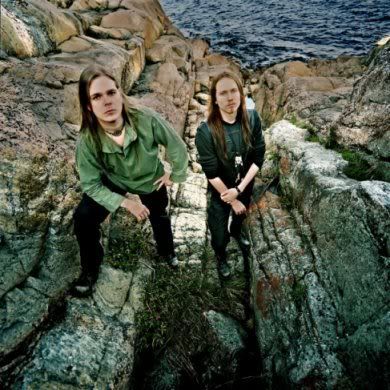
Vintersorg


Vintersorg (pronounced ['vɪntɛr 'sɔrj]; "Winter Sorrow" in English) is a Swedish band from Skellefteå, Sweden, formed in 1994 under the name Vargatron (Wolfthrone in English). Musically, Vintersorg has covered a wide number of heavy metal genres; while the band is mostly rooted in extreme metal styles, particularly black metal and Viking/folk metal, it has also expanded into progressive metal and avant-garde metal. Lyrically, the band deals with topics on fantasy, mythology, nature, the cosmos, and metaphysics. Vintersorg means "Winter Sorrow," but the name was taken from the Isfolket series by Margit Sandemo, where the character Vintersorg is the son of a great pagan leader.

The project was originally formed in 1994 to "push the limits" of black metal music, where the vocals are mostly clean sung, and only a few parts per song that had the traditional screaming vocals. The sound of Vintersorg has vastly changed over the years, as their earlier sound had more of a folk influence, and later on, more of an experimental sound. This transformation was most notably marked with the release of the Cosmic Genesis album, and the change in sound progressed from album to album, with the 2004 album The Focusing Blur being an extremely avant-garde album. The band's vocal elements have changed from album to album as well, starting out with low-pitched, powerful baritone singing, and gradually shifting towards softer, higher-pitched delivery with more use of harmony and layering with black metal vocals. The band's most recent album, Solens rötter, marks a return to the earlier folk metal style, while retaining the more complex and non-traditional guitar arrangements and song structures of later albums.

Along with this change in musical style, the lyrical topics began to shift as well. On earlier albums, the lyrics are all written and performed in Swedish, and dealt with topics of nature and paganism. With the advent of Cosmic Genesis, the lyrics were now written and sung mostly in English, and now dealt with scientific ideas and philosophies such as metaphysics, astronomy, and astrology. In the Cosmic Genesis booklet, Vintersorg extends thanks to Dr. Carl Sagan, author of the book Cosmos. Since, then, the band has alternated between both English and Swedish lyrics, sometimes using both on the same album. In keeping with the band's return return to its folk roots, Solens rötter is also sung entirely in Swedish and deals with more traditional themes.

Vintersorg (aka Andreas Hedlund) is constantly creating music. He is the front-man of several bands including Vintersorg, Otyg, Borknagar, Havayoth, Fission, Cronian and Waterclime.